In a recent conversation, an engineering leader highlighted success as how quickly managers jump in and close escalations. Crisis skills matter: calm triage, clear communication, decisive calls. The leaders I admire do that and then make tomorrow quieter.
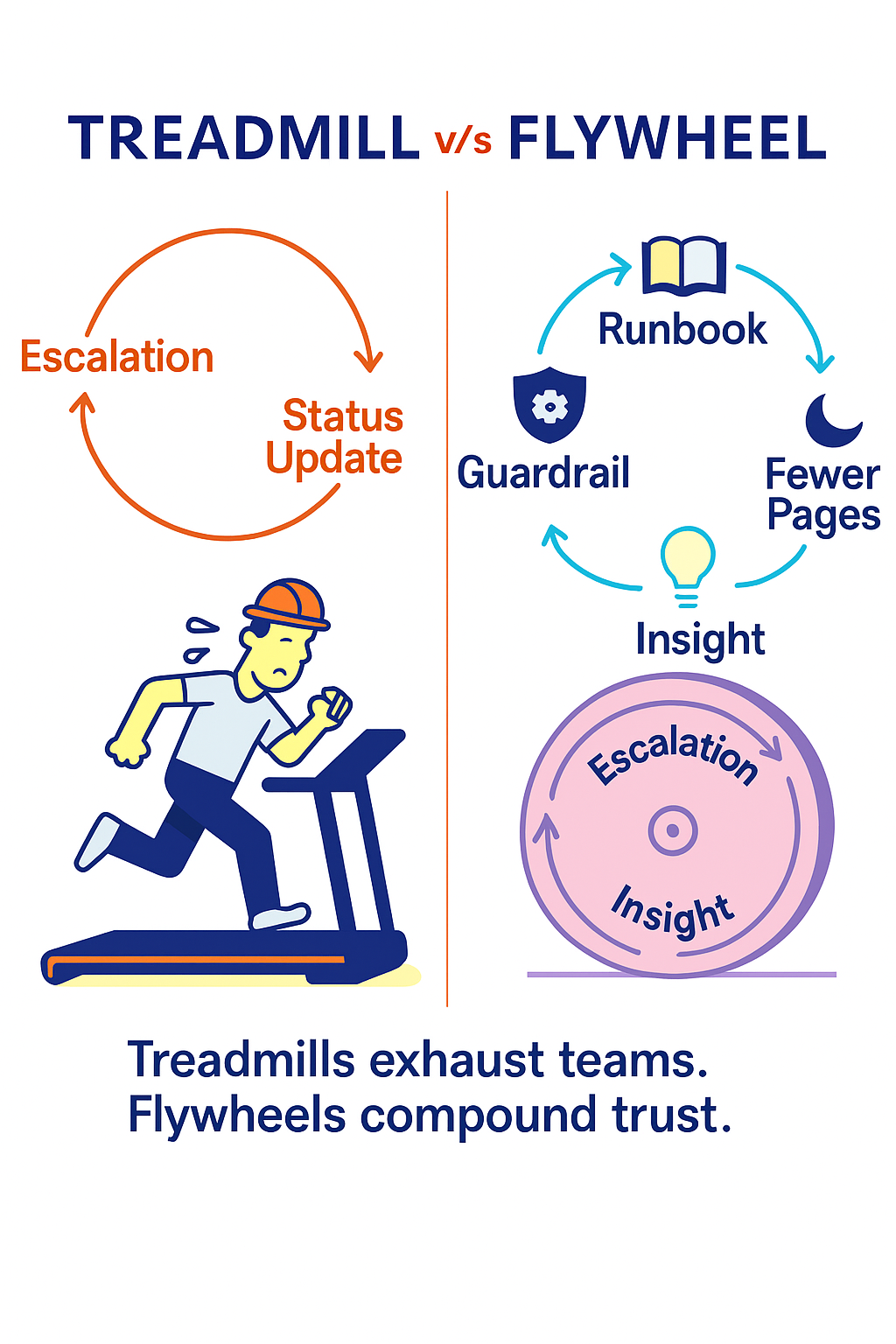
Use the visual above in your mind as you read:
-
Treadmill: escalation → status update → next escalation
-
Flywheel: escalation → insight → guardrail → runbook → fewer pages
The goal is simple. Keep the ability to respond under pressure. Turn every incident into a small step that reduces the chance and impact of the next one.
What the treadmill looks like
-
Status meetings move faster than learning.
-
Fixes rely on a few heroes.
-
The same alerts reappear with new ticket numbers.
-
Confidence rises after a hot fix and fades by the next release.
What the flywheel looks like
-
Each escalation produces one clear insight.
-
Insights become guardrails: SLOs, timeouts, backpressure, flags, canaries, rollback.
-
Guardrails are backed by a short runbook that anyone on call can follow.
-
Fewer pages arrive next week. Confidence accumulates.
Turning an escalation into a flywheel step
Capture the insight
One sentence. Example: “Cache stampede on product detail under peak traffic.”OR,
a 5-whys style root-cause: Example:
- Why did latency and 5xx spike on the product page?
- Many concurrent cache misses triggered recomputes that overloaded the source service.
- Why were there many recomputes at once?
- All pods refreshed the same hot key when the TTL expired at the same moment.
- Why did they all refresh simultaneously?
- No single-flight or request coalescing, and no stale-while-revalidate path.
- Why were those mechanisms missing?
- The caching library used plain GET/SET with a hard TTL and no jitter.
- Why was the library that limited?
- Caching patterns were not standardized; the design checklist lacked “cache truth” and dogpile control, and ownership was unclear.
Add a guardrail
Examples:
- Stale-while-refresh to limit stampedes
- Idempotent handlers and retry policy
- Circuit breaker and explicit timeouts
- SLO with burn alerts
Write the runbook
One page or less. Triggers, commands, owner, rollback, verification checks.Practice once
A team drill. Prove that anyone on call can execute it.Measure fewer pages
Track pages per week and time to rollback. Expect the curve to bend.Guardrail starters that pay off quickly
-
Deploy and release are separate. Use feature flags.
-
Releases are reversible. Keep a tested rollback for each change.
-
Requests fail predictably. Timeouts, budgets, and backoff.
-
Data paths are safe. Idempotency for writes and migrations.
-
Traffic is honest. Rate limits and backpressure at ingress.
-
Observability is ready. Dashboards for latency, errors, saturation, cost, and “what changed”.
A tiny runbook template
-
Trigger: when to use this playbook
-
Checks: dashboards to open
-
Actions: commands or steps
-
Decision points: continue or roll back
-
Rollback: exact steps
-
Validation: what good looks like
-
Owner: who has the baton
Metrics that make tomorrow quieter
-
Pages per week and per person
-
Mean and p95 time to rollback
-
Incidents per change
-
Guardrail changes per week
-
Percentage of changes that are reversible
-
Preventive work completed each sprint
Keep them lightweight. Learn, do not blame.
Roles: manager vs leaders
-
Managers close escalations and keep the queue moving.
Leaders turn escalations into guardrails, training, and fewer pages across teams. They scale prevention.
Anti-patterns to retire
-
Status without a design change
-
Hero mode as a habit
-
Postmortems that name people instead of conditions
-
Big-bang fixes with no rollback
TL;DR
Firefighting builds short term credibility. The best leaders turn that credibility into quieter systems by scaling prevention, not just response.
Choose the flywheel.